 Case Study · South-East Asia
One of South-East Asia's largest online electronics retailers — invisible online.
GQ Mobiles runs a catalogue of over 1,000 products — smartphones, tablets, wearables, audio, and consumer electronics. Broad inventory. Serious buyer intent. A real business behind the scenes.
But when a customer opened Google looking for any of it, GQ Mobiles didn't show up. The digital storefront existed — search engines, and the millions of buyers using them, simply didn't know it did.
The numbers, before we started.
0
Organic impressions
0
Clicks from search
0
Ranking keywords
1,000+
Products in catalog
Traditional SEO — pick a few keywords, write some blog posts, wait for rankings — would have taken years to move a catalogue this large. It was never going to work.
The promise we made: no overnight guarantees, no vanity metrics — just measurable, compounding growth from zero to dominant regional presence.
Before strategy, an engineering call — decouple everything.
We brought marketers and developers into the same room and made a foundational decision. Split the frontend and backend — without compromising the client's familiarity with WordPress and WooCommerce. Next.js on the frontend. Headless WordPress with GraphQL on the backend.
Next.js (SSR)
Fastest server-side rendering of any comparable framework on the market.
Headless WordPress + WooCommerce
The client's team manages 1,000+ products without a developer in the loop.
GraphQL (WPGraphQL)
Typed, decoupled API feeding the frontend at speed.
RapidLoad AI + CDN
Core Web Vitals treated as a ranking signal from day one.
Four constraints. One architecture that solved all of them.
- A 1,000-product catalogue had to be maintainable by the client — not locked behind developer dependency.
- Every product update, price change, and new listing had to propagate instantly and cleanly to the frontend.
- The system needed to grow — new categories, new product lines, new markets — without a rebuild.
- Core Web Vitals have become solid ranking signals. We needed to win on performance, not just content.
1,000 products. Every one a search-ready landing page.
Most agencies approach e-commerce SEO the same way: pick some category pages, add meta descriptions, pray for the best. That doesn't scale to 1,000 SKUs. So we built something that does — a generation pipeline that ships every product page optimized, schema-marked, and ranking-ready from day one.
Product-specific meta, not templates
Keyword-rich, genuinely differentiated titles and descriptions for every SKU — not swapped tokens in a template.
Custom structured-data schemas
Product, Offer, Review, Pre-order, and BreadcrumbList — refined for days until Google returned a perfect match in rich results.
Live attributes injected at render
Pricing, availability, variants, and specs fed to search engines as real-time signals — never stale.
Category pages with topical depth
Collection pages built to be destinations, not just navigation. Every category became its own ranking surface.
The outcome: every single product in the catalogue became a discrete, optimized landing page with its own search identity. A customer looking for a specific smartphone model in the region didn't just find a generic retailer — they found a page built precisely to answer their query.
Brand awareness over generic keywords.
For a new e-commerce brand in a competitive regional market, fighting for “buy smartphone online” is a losing proposition. The domain authority isn't there. The budget to compete isn't there. Even if you rank, the conversion intent is low. So we did the opposite — and it compounded.
Long-tail product queries
Specific model names, variants, and configurations where GQ Mobiles could win immediately — before spending a cent on authority.
Brand-adjacent searches
Topical authority built around every category GQ Mobiles operated in — so Google saw the site as a credible answer, not a generic retailer.
Decision-stage queries
Comparisons and buying guides — reaching customers who were days, not weeks, away from purchase.
9.76 million impressions — built the right way.
Early wins on niche terms built domain authority. Authority unlocked visibility on broader terms. We never chased the volume — we earned it.
In South-East Asia, slow doesn't just lose users — it loses rankings.
Mobile-first browsing, varied network conditions, and competitive app-like experiences mean that a slow website isn't just a UX problem — it's a ranking problem. We treated Core Web Vitals as a core engineering requirement from day one, not a late-stage optimization. We built RapidLoad AI — the WordPress speed plugin powering 10,000+ sites globally. So yes, we know what we're doing.
Faster pages
Sub-second SSR from Next.js
Higher rankings
Core Web Vitals feed into signals
Lower bounce
Users stay — Google notices
Stronger index
Virtuous cycle, built in
Powered by RapidLoad AI
The same autonomous performance platform we built — trusted by 10,000+ WordPress sites globally — deployed here for maximum Core Web Vitals scores.
From zero to regional dominance.
More than traffic. 9.76M impressions established GQ Mobiles as a recognized brand across South-East Asian search — visible to buyers at every stage of the purchase journey.
Google Search Console · 16-month window
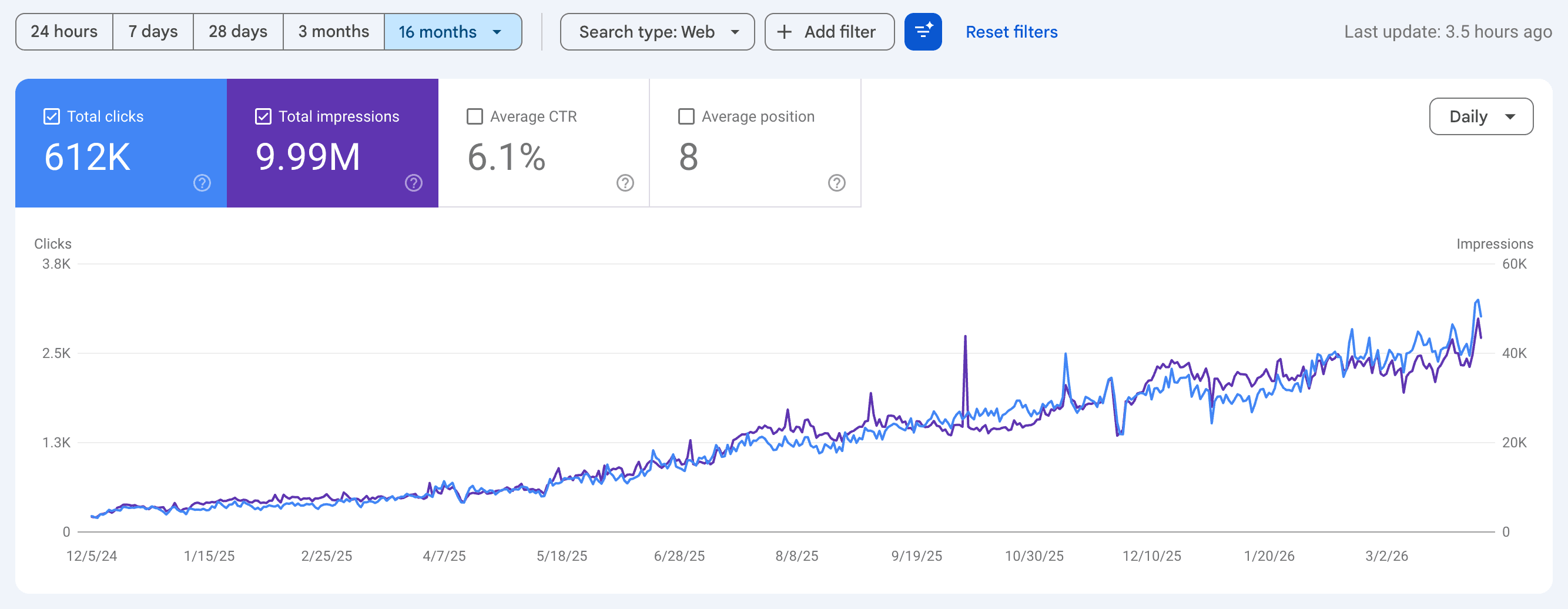
Flatline for months. Then the compounding kicked in — a steep, sustained climb driven by hundreds of product pages hitting page one in parallel.
A platform that doesn't need us to run.
A platform that performs brilliantly but requires constant developer intervention isn't a feature — it's a liability. From day one, we built GQ Mobiles' system around the client's operational reality.
The Headless WordPress CMS gives the GQ Mobiles team full control over their catalogue. No code. No tickets. No delays. And as new product lines, categories, and markets roll out, the architecture scales with them — not against them.
What the GQ Mobiles team can do on their own.
- Add new products in minutes — no tickets, no devs
- Update pricing and inventory through a familiar interface
- Spin up new categories and product lines without a rebuild
- Keep the catalogue fresh — which feeds both trust and SEO signals
We don't just build. We grow your business.
9.76M impressions. 596K clicks. 3M views. Zero to regional dominance in 16 months — and still compounding.